Showing posts with label Mechanics. Show all posts

Tuesday, July 28, 2026

Stolen Board Game Mechanic: Divide-and-Choose Spells

Various types of boardgames and card games include “I cut, you choose” mechanics. One player divides a quantity of tokens, or cards, or some other discrete game element into two piles, then a different player gets to pick among those piles, with the first player receiving the remaining selection. Like unchosen picks accruing value, divide-and-choose is interesting because it is self-balancing. The divider is incentivized to make as even a split as possible, unless they have access to information the chooser does not, or believe that the chooser is otherwise unlikely to pick correctly.

How could we apply this to D&D-style games? Consider divide-and-choose as a magic system.

Assume each spell has three major effects. The caster separates them into one pile of two and a remaining pile of one. The target of the spell can choose either pile.

For example, imagine that Fireball had the following effects: Area Effect; Fire Damage; Burning Condition.

The caster divides; they offer the target either Damage OR Area Effect + Burning Condition. The target is low on HP, so they take the Burning Condition and Area Effect, which spreads the Burning Condition to several of their allies. 


Video games provide plenty of ideas for effects. Area and range, damage increases, damage over time, all kinds of “debuffs,” poison or disease, fear and charm, and so forth. 

Some care has to be taken to avoid making one choice much weaker or much stronger than the others, such that the divide-and-choose would become trivially obvious. But this approach also makes it possible to add niche effects that wouldn't otherwise be "worth" including.

Consider a spell that forms a cloud with the effects Poison, Obscuration, and Coughing. The Poison and Obscuration effects are probably more broadly useful, and would typically be split, so that at least one would apply. But if the target is a spellcaster, and Coughing could prevent them from intoning arcane words, it might be viable to divide such that Coughing is alone and Poison and Obscuration are together, forcing the target to accept both Poison and Obscuration if they want to avoid Coughing and be prevented from casting spells.

A spell is not necessarily limited to three choices. A higher-level spell could involve four, five, or more choices. But we should be careful about how many we offer; too many choices and the divider will take too long picking their piles, dragging the game to a halt. 

Tuesday, June 30, 2026

Another Card-Based Method for Wrapping Up a Campaign

TTRPGs provide a lot of assistance for beginning a game and a lot less for ending oneI’ve written before about using cards to wrap up a game. Late last year, we wrapped another game with cards. The situation was as follows.

  • We were wrapping a multi-year game, and the PCs had finished everything that we wanted to address through conventional, moment-to-moment play.
  • We wanted to "zoom out" from a typical session's focus and resolve some big questions without rolling the dice. 
  • The PCs had two goals that were in tension with each other.
  • We wanted to break the action into separate stages to define gradients of success and failure.
  • We wanted danger, risk, or conflict embedded both in the individual stages, but didn't want any particular resolution to be too time-consuming.
For brevity’s sake, I’ll skip the in-fiction details and focus just on the mechanics of the process.

The PCs needed to get through 14 “phases” to achieve their two goals. To ensure we could complete the finale in one session, I used a timer, with the PCs compelled to move forward to the next phase. Each phase began with two face-down playing cards, which the PCs revealed when they began the phase. I had the 14 phases laid out on the table, and the two cards were placed in columns on either side of each phase.

In addition to the face value of numbered cards, jacks were worth 11, queens 12, kings 13, and aces were wild cards, worth either 1 or 14, at the players’ discretion. The gap between the numbers on the two cards indicated the danger of the current phase. A difference of 0-2 indicated minimal danger; 3-5 signified moderate danger; and 6 or higher suggests extreme danger. I had concepts planned for how danger might manifest in each phase, as well as some general danger-escalation tools that could be used at any stage.

To determine how well their efforts to deal with a dangerous situation were going, they could draw a card from the top of the deck and add it to either side. So if a 3 and a 9 were revealed for either side of the phase, creating a danger score of 6, and a player drew an additional card and revealed a 5, they could add it to the side with the 3 to bring that side up to 8 and the stage's overall danger margin down to 1. The six characters in play had three chances each to add a card in this manner, for a total of 18 among the group. To use one of these draws, the PC had to “flash forward” to one of three epilogue moments – one day later, one month later, and one year later.

Here’s the catch. In addition to resolving the danger of the present stage, the running totals of each column will determine if they players achieved one, both, or neither of their overall goals (separate from the danger in each phase). 

So the players needed to balance the phase-by-phase spread against the running totals for their two goals. These two incentives could easily conflict, where they needed to "make up" a difference in the overall goal totals by leaning into danger in some of the stages. The players in my game were actually forced to make the last stage much more dangerous for themselves in order to get their goal numbers to where they wanted them to be.

We handled all of this narratively, using NPCs, abilities, resources, and the flash-forward epilogue moments to interpret the results of the revealed cards. No dice were rolled during this session. But there’s no reason (besides time) that something like this couldn’t be used as a “progress clock”-style overlay on regular game action.


A diagram indicating how the succession of cards across phases creates running totals toward the goals


Difficulty 

I decided that a final difference of 4 or less would indicate both goals has been completed successfully, while 5 or more would involve compromising or partially failing at least one of the two goals. I didn't go too deep into calculating the odds here, but I think I was lucky that the cards provided some tension that forced them to act, as there is a non-trivial chance that the numbers on the cards could balance themselves too easily and let the players move forward passively.

Fortunately, it is easier to make this harder in one of several ways:

  • Decrease the margin for success on both goals; for example, say that a margin of 2 or less is required to succeed on both goals, with 3-5 succeeding on the higher-value goal only, and a difference of 6 or more indicating that both goals fail.
  • Set Aces to 14 only, rather than allowing them to be wild cards. 
  • Remove the 2s, 3s, and even the 4s from the deck. The game will become swingier without the low cards, with more phases showing high levels of danger. 
  • Allow for fewer interventions to add cards to balance out danger.
  • Instead of measuring the success of both goals by the final margin, give the two goals separate (and conflicting) success states. For example, one column could succeed on a high score, while the other could succeed on a low score. This would essentially force the players to choose one over the other, partially influenced by the randomness of the cards. 

But Why Tho?

To some degree this is just a different way of getting to what is really just a progress clock or skill challenge. Dice could simulate this in a way that is closer to the conventional game action. 

But I think there is something for switching systems entirely to frame an epilogue. After spending an entire campaign rolling dice to resolve moment-to-moment action, the cards signposted that the resolution system here was going to be different. 

The cards also provided a good visual centerpiece for the session. When I run games in person, I'm mostly happy to do it with few maps and props. But I have noticed that players benefit from having a shared visual thing to look at, particularly when the session has a very specific shared objective like this. 

Tuesday, May 12, 2026

Oops-All-Backgrounds D&D

I have written before about the underrated design of the backgrounds in D&D 5E.2014. Backgrounds in 5E include a brief description and some “suggested characteristics,” but mechanically they boil down to the following pieces: 

  • Two skill proficiencies
  • Usually one or two tool proficiencies (although a few backgrounds don’t get any)
  • Usually one language (although again, a few backgrounds don’t receive one)
  • A brief starting equipment package
  • A “feature” that doesn’t have an explicit mechanical application, but exists entirely as something to be leveraged by the player and adjudicated by the DM. Usually the feature grounds the character within the game’s social milieu.

This is a solid chassis for a starting character, even without ancestry and class. The problem with backgrounds in the context of 5E is that they are quickly swallowed up by class progression. Those background details may come up in the first few sessions, but nobody bothers to use the Rustic Hospitality feature by level 5, let alone level 20. 

But… what if they weren’t competing with the classes? What if instead, the classes were designed like backgrounds? What if... the fighter class just looked like this?

  1. Skill proficiencies: Choose two, just as you normally would, from the 5E fighter skill list
  2. Armor proficiency: Choose one from among light armor, medium armor, or heavy armor
  3. Weapon proficiencies: All simple weapons and any three martial weapons
  4. Equipment: Same options as the in the 5E fighter list
  5. Feature: Choose either Action Surge or Fighting Style


An illustration titled "Lancelot and the Dwarf" from The Book of Romance, depicting Lancelot approaching two lions, with a dwarf moving in the other direction, appearing to knock the sword out of Lancelot's hand, or possibly fist-bump him as he drops it


And what if the dwarf ancestry just did this? 

  • Weapon proficiencies: Battleaxe, handaxe, throwing hammer, and warhammer
  • Tool proficiencies: Artisan’s tools of your choice (smith’s tools, brewer’s supplies, or mason’s tools)
  • Languages: Dwarven
  • Feature: Choose either Darkvision or Dwarven Resilience

Any one of these is an MVP (minimum viable PC). Where you go from there depends on what kind of game you want. If you want to hew closer to normal 5E, layer on additional features and mechanics as class advancements, but keep it much leaner than typical 5E. Use GLOG-style progression as a model, with maybe four levels, capping characters at a low/middle power level, just like you might when using a 5E chassis to run a megadungeon.

If you want to keep it simpler, instead model the game on a system that features little or no advancement, like Troika, or one of the Into the Odd-based games. Or assume that advancement comes mostly from exogenic acquisitions, as in an equipment-focused game like Knave.

Tuesday, March 31, 2026

Studying Noita to Build Deadly Dungeons

I have played 137 hours of Noita, because apparently I enjoy suffering. Noita is a roguelike videogame in which you explore randomly generated biomes, find customizable magic wands, and use them to kill enemies. Watch a few minutes of any video on YouTube and you’ll pretty quickly get a sense of the vibe. Like many videogames, it can be mined for TTRPG ideas.

Danger from Above

Like D&D, Noita is (mostly) a game about going down, down, down into the depths of what is essentially a dungeon. Many (but not all) enemies attack more effectively downward than they do upward. You can clear them as you descend, but both enemy behavior and level architecture become more complex and challenging. Many deaths begin when an enemy attacks laterally or unexpectedly from above, or when multiple enemies apply pressure from different directions. 

And it is not just the enemies. Noita is also famous for simulating liquids pixel by pixel. A lot of this liquid is pretty dangerous. That looks like this.

A gif from the videogame Noita, depicting the protagonist shooting the edge of a container filled with deadly liquid, so it floods out on enemies below


A stray shot, trap, or an enemy-induced explosion can send liquid pouring down on your character. And enemies who have the high ground will often knock your character into toxic, acidic, or flammable substances. Many Noita runs end not exclusively through enemy attacks, but through some combination of enemy action, environmental hazard, and player error. 

So ask yourself, what materials or substances are abundant in the dungeon, and how could they be exploited by the dungeon denizens (and, in turn, the PCs)? Baking this question into the dungeon’s design means that players are rewarded for understanding and anticipating what the dungeon is about.

Danger from Below

Again as in D&D, Noita monsters get stronger and hazards grow more dangerous with each level you descend. But the deeper you go, the better the loot you find.

Dropping an explosive on an enemy's head can be a relatively safe way to defeat it. But if that enemy is near some fragile treasure, like a potion, you might easily destroy it (and flood the area with the potion's potentially dangerous contents). And good luck getting the gold the enemy dropped if you also set fire to their surroundings.

Some monsters will fight other types of monsters, and it’s pretty typical to hear combat well below your character, out of sight. Listening carefully will alert you to the presence of something that can kill you on sight.

An attentive DM will often telegraph noises from another room on the dungeon level. But how often do you telegraph sounds from another floor? When can you give PCs a clue (or warning) about what is going on under their feet?

Danger from Yourself

Noita’s customizable wand system makes it quite easy to build wands that are as dangerous to the player as to the enemies, and you won’t have to play the game for long before ending a run with “Minä” listed as the cause of death; which is to say, you accidentally took yourself out.


An animated gif from the game Noita, picturing a player moving quickly through the game's environment, then accidentally polymorphing themself into an enemy and being killed by their own enemy-seeking projectile


I find this to be a particularly rich vein to tap for magic items in roleplaying games. Some of my favorite items of all time have been things that my players were too scared (too wise?) to actually use them as much as I would like. I can't exactly blame them. They can’t respawn and start a new run as easily as I can in Noita. But taking the safeties off the magical items really sells the danger and opportunity of the game's world.

Tuesday, February 17, 2026

Stolen Board Game Mechanic: Add Value to the Unpicked Choice

Spots is a push-your-luck dice game. Players take turns choosing action cards, which dictate how they roll dice that turn. After they take their turn, the action card they chose is exhausted for the round. When all but one action card has been chosen, all actions are refreshed and the process begins again. This is arguably a form of Dutch auction, although with accruing value instead of decreasing price.

Pretty straightforward, right? But there’s a small rule that is secretly important to the game. The final action card that was left unselected gains a token that allows for a one-time reroll of the dice. Whoever picks that action card next will get to keep any tokens that have accumulated on the card, and can spend those tokens later. So if the players favor certain cards over others (and most players will), the unpopular card(s) will gradually accrue additional value as more tokens accumulate.


An animated gif of a six-sided die, with the number six on each face


This mechanic is great because it automatically "balances" the perceived power level of the options available to the players. It doesn't matter if that’s an actual play design imbalance, where some choices are better than others, or simply a preference among the players for a certain style of play. The imbalances between the choices are self-correcting over time, as some quantity of tokens will eventually bring a less-popular choice into competition with the more popular ones.

Consider applying this mechanic to discrete, mutually exclusive choices in an RPG. For example, consider downtime for a party of three PCs in a fantasy adventure game like D&D. Each time they return to town, each PC can choose one of the following (in addition to resting): level up, gather information, carouse, research, or shop. Only one player may choose each action, and each player only gets one choice.

Player A chooses leveling, player B chooses research, and player C chooses shopping. Gather information and carouse go unchosen, so they each get a token that allows for one in-session reroll of the dice. Whoever chooses these options in the future gets to keep any tokens associated with that choice. Even if carousing or gathering information goes several downtimes without being chosen, the accumulation of tokens will eventually compel someone to take them.

Tuesday, January 20, 2026

Rolling for Shoes and Quantum Gaming

I greatly enjoy "quantum" game mechanics. In this context, all that means is some aspect of the game that would typically be predefined is left undefined until its definition is specifically required by the events of the game. Various games use quantum mechanics without naming them, but one of my favorite articulations is this one by Luka Rejec

In a pinch, I would probably use Roll For Shoes by Ben Wray, or freeD6 down the line by Liche’s Libram for a quantum chassis. I particularly like the idea that basically anything can be a character skill (allowing for quantum character construction and a negotiated understanding of the game scenario), but that the randomness of the dice ensures that characters have choices and risk/reward calculations; they can’t just add skills indiscriminately, or they’ll end up with low ones that the GM can force them to test. These games also require nomic negotiation between the players to decide how to interrupt unclear overlaps and edge cases.

I do want to try running Roll For Shoes as-is, but I have also put some thought into a slight variation on it that makes it less of a d6 die pool system and lets it tack closer to D&D abilities and d20 resolution. All you need are 3d6 and 2d20, as well as a way to take notes. So you can run this game entirely from your phone, if needed. The game requires at least one GM and at least one player, although it could be played solo with an "oracle" replacing the GM.

An animated gif demonstrating quantum fluctuations.

The procedure is as follows:

  1. The group chooses a genre. The GM should be at least as familiar with the genre as the player or players are. 
  2. Choose a goal. It should be very general, but within the confines of the genre. Don’t think too much about who the characters are yet. A goal could be “defeat the evil overlord” or “win the reality TV show” or “steal the huge diamond from the gallery.”
  3. Each player chooses a very minimal character concept. This should be as bare-bones as possible. It could be an occupation, a background, or something else. Basically a one-sentence premise, just enough to explain why this person is present in the opening scene.
  4. The GM begins the game. Play starts with an opening scene, usually something that will bring the characters together (if there is more than one) and either establish how they know each other or allow them to meet for the first time.
  5. When a PC has to do something uncertain, they roll 3d6. This becomes their permanent ability stat (or skill, or whatever term you prefer) for that action.
  6. Whenever a player needs to test that stat (including immediately after that first 3d6 roll), they roll d20. A result equal to or lower than their stat is a success. The GM may give them advantage or disadvantage on the roll.
  7. If a player rolls something really low on 3d6, they can choose not to test it and can try to approach the situation in a different way. But the result of that 3d6 roll stays on their character sheet.
  8. Failed d20 rolls create new antagonists, hazards, obstacles, complications, or other threats. This could be anything in the story that the GM can use to trip up the players. The GM writes it down, along with the number that the player rolled that resulted in the failure. So if the player has an Argue stat of 13, and then rolls a 16 on a test when trying to convince the studio boss to greenlight their movie, the GM notes “Studio Boss: 16.” 
  9. Whenever a number associated with a threat is rolled by anyone, that threat can reappear. It doesn’t matter if a different player rolls the number, or if the PC whose failure led to the creation of the threat is present or not, or even if the roll in this instance was a success (because it is rolling against a higher stat). If the GM thinks it makes sense for the threat to appear, it can happen.
  10. The story ends whenever everyone thinks it has reached a natural ending. Or…
  11. Alternately, the story can end when the game reaches a predetermined number of one or more of the following criteria:
    1. Successes. X successful checks against stats are enough to complete the goal.
    2. Failures. X failed rolls on stats are enough for the goal to fail.
    3. Threats. X threats created are enough to ensure the PCs will fail to complete the goal.
    4. Stats. Each character can have only X stats, maximum. Once they’ve reached this maximum, their next failure will knock them out of the story in some fashion or another. If all the PCs are knocked out, they fail to complete the goal.
I'm keeping this in my back pocket in case I need a quick, improvised RPG. If I have an opportunity to try this, I will report back.

Tuesday, September 16, 2025

Defining the Six Classic D&D Stats

D&D has six core stats. If you can grasp these six stats, the rest of the game is pretty easy to understand. 

Strength. Strength refers to the concentration of the liquids your character can create and use. This can include everything from truth serum to deadly poison.

Dexterity. Dexterity is a made-up word that the game’s designers created because dextroamphetamine was too long and confusing for many players. Dexterity measures the character’s level of stimulation and ability to stay up all night – a very useful ability.

Constitution. Constitution measures a character’s ability to understand, enforce, subvert, or modify the documents used to establish governments and nation-states.

Intelligence. Intelligence, or “intel” for short, measures the quantity, quality, and exclusivity of the secret information a character can obtain.  

Wisdom. Your wisdom modifier (not the score itself) determines the number of wisdom teeth you have, measured against a baseline of the most common number of wisdom teeth (four). So someone with a +2 wisdom modifier has six wisdom teeth. Remember that wisdom controls most tooth-related game mechanics, e.g., determining if you can safely implant a false tooth filled with cyanide. New players often underrate the Wisdom stat, but it comes up more often than they expect.

Charisma. Charisma determines your affinity with (or opposition to) Charisma Carpenter. As the true power behind many of the events in the game world, Charisma Carpenter can be a powerful ally – or a formidable threat!


And that’s it. Most of the rest of the game is built on this foundation, so it should be really intuitive to learn once you’ve internalized these six definitions. I know this was a little more basic than most of what I post here, but I’ve been surprised by how many times I’ve had players join a game expecting these abilities to do something completely different, so it seemed worthwhile to clarify the real definition of each ability.

Tuesday, August 26, 2025

Should Party Pace Be a Player-Facing Mechanic In More Games?

Should PCs in party-based roleplaying games – particularly fantasy dungeoncrawls – more explicitly choose their pace of exploration?

The following is implicit in how I adjudicate situations on the GM side, but it isn’t something that players historically see in a plainly stated way. I infer their pace from the actions they choose, and then rule accordingly. But I’ve been thinking about what it would look like if party pace was a formal, player-facing mechanic. 

I’ll mention advantage/disadvantage here as a shorthand, but equivalent benefits and penalties could easily be substituted for games that don’t use that mechanic. 

I’m certain this isn’t a brand-new idea. I’m sure there’s are systems and play styles that handles party pace in a similar manner. Pointers appreciated if what I'm describing is very close to something that is already out there.


Methodical. The party is moving very slowly, basically a crawl. 

Assuming ample light and no direct obfuscation, hidden information is typically found without any special action by the party. They have advantage on rolls to find secret information. The party is assumed to be moving stealthily, within reason, and may gain advantage on related rolls.

When moving methodically, the maximum amount of time passes – this is as slow as they can go. A random event is essentially guaranteed, although the party may gain advantage on a surprise roll, or some similar benefit. If there is a clock for antagonist action, or any other time pressure beyond random encounters/events, it will almost certainly advance.


Cautious. The party moves at a slow, steady walking pace.

The party can choose to focus on searching or stealthing, but not both. If the former, as long as they have decent light, they have advantage on rolls to find hidden information. It’s possible to find secret information, but will require pointed inquiry. Stealthing foregoes both the hidden and secret information, but is otherwise practical at this pace.

If some PCs want to search and others want to stealth, they can, but they must split up. Note that stealthing ahead of searchers and searching ahead of stealthers both present complications and dangers for the party. The traditional stealthy-character-scouts-ahead role is, by definition, limited to the Methodical pace.


Balanced. The party moves at a brisk walk.

This is the default party pace. Hidden information can be found with careful questions, but won’t be exposed by default. Secrets are almost never found at this pace. Stealth is difficult or impossible (usually requiring at least disadvantage on an applicable roll).


Fast. The party moves at a hurried pace, like a steady jog, or quick dashes from point to point.

Hidden information and secrets will not be found, but the PCs will still see landmarks. Mapping or orienteering is very difficult (roll with disadvantage, if it is possible at all). Less time passes, but random encounters/events will happen at about the same frequency as the Balanced pace, because the party is more conspicuous. There’s an increased chance for lights to be extinguished and for similar complications. No stealth. If characters moving at a Fast pace run into an encounter that could turn hostile, they probably have a good opportunity to run away. If they give chase to someone who flees from them, they have a good shot at keeping pace with them.


Reckless. The party charges forward, headless of the danger.

Random encounters/events trigger automatically, although there’s at least a good chance the PCs can outrun some of them. Organized non-local antagonist action doesn't really happen because there just isn't much time passing. Players may need to either stow or drop held objects. The party is only dimly aware of their surroundings as they move. No mapping or orienteering. Not only will they miss all hidden and secret information, but they may need to roll just to spot landmarks.

When moving Recklessly, the party can usually escape typical combat encounters (either without a roll, or rolling with advantage), but are likely to be separated or lost when doing so. They have advantage on rolls to escape a pursuer or catch quarry.


Moving at a reckless pace AKA me when I win at Bang! as the Renegade with a Mustang and no other gear AKA I will use any excuse to add Golden Kamuy to a post 


After Them!

We usually don’t care about the pace of monsters or NPCs, but in a chase scenario, it becomes important. PCs or monsters moving a category faster than their pursuer/quarry have advantage on rolls to escape/catch them. PCs or monsters moving two categories faster will escape/catch up as a matter of when, not if. Think about a monster’s abilities when adjudicating this question; some will only use one or two of the movement conditions above. Fleeing from an air elemental should feel dramatically different than fleeing from a giant slug.

Switching Gears

Moving to a faster or slower pace is always possible when conditions are normal and the PCs are in no direct danger. If they are in danger, they can only move down the list, toward the faster paces. Assume they can move by one category per combat round or equivalent unit of time. If a party is moving Methodically and suddenly is drawn into combat, they probably can’t immediately pivot to Fast or Reckless retreat; they need to change pace one stage at a time.

Certain circumstances may almost force them to change their pace. This kind of procedure can add a lot of spice to something like fear effects; frightened characters can only move down in the pace list, toward the faster categories, even if they're not in direct danger (and they may perhaps be compelled to do so, even if other characters do not do the same).

Splitting Time

If the party is moving at different paces, assume that a faster group can take twice as many actions for every step separating them. But they should also get more limited information during that process, in accordance with the landmark/hidden/secret distinctions above.

Player-Facing or Player-Unknown?

I’m always fascinated by which procedures and mechanics are player-facing in a game, and which are not. I don’t think any of the above needs to be player facing. In the old-school context, I endeavor to adjudicate the dungeon’s reaction to the players accordingly, and the players trust me as a fair referee to present the dungeon’s response to their presence in a measured and plausible way. 

But making this mechanism player-facing has a certain appeal for teaching the playstyle to modern players. Divorced from the Strict Time Records of yore, modern/OC/5E-style players will choose to do almost everything Methodically. And why wouldn’t they? What is the incentive to go faster if there are no clocks, no wandering monsters, no proactive enemy responses to their presence? I believe the above procedure, or something like it, can help them grok the pros and cons quite well.

Tuesday, June 24, 2025

Finding Your Own Meaning in the Dungeon

Why do the adventurers care? Why are they here? Why are they in the dungeon at all?

“Weak hooks” are a common point of criticism in adventure reviews. The reviews are not wrong, but I’m sympathetic to the adventure writers here. It is difficult for a standalone adventure to hook players. The product is implicitly available to drop into an existing game. The writer is trying to come up with something that will be specific enough to foreshadow the adventure and motivate the players toward it, but at the same time general enough that it can be dropped into any game with minimal modification. That’s a narrow target to hit. Good hooks are hard!

Good games are powered by motivation. Even in the grottiest old-school game, where the PCs aspire to little more than shivving goblins for copper coins in a dank hole in the ground… play that game long enough, and those PCs are going to develop some kind of purpose or goal. They may not set out to save the world, but they’re going to organically come up with some kind of goal, whether it is stick it to their rivals, get rich, build something cool, make history, or simply find out just how deep this dungeon goes.

So here’s another idea. This has big story game energy, so it’s not going to be for everyone. But… I would be curious to try it. 

Write five hooks (rumors, leads, whatever) for your adventuring scenario. One for each of the following categories:

  • Wealth: The accumulation of resources, from common coins to unique works of art.
  • Status: Importance in the eyes of other creatures, whether mundane societies or mystical peers
  • Knowledge: Secrets, lore, or new discoveries about the world and its wonders.
  • Purpose: A belief, cause, or principle that gives meaning to life and justifies risking danger.
  • Change: Altering the world in some way, whether to effect a very particular change or simply to leave one’s mark. 


An animated gif depicting rotating gold bars


When the PCs decide to take up the scenario, each player chooses one of the five hook types. The hook that the most players pick is the party’s shared motivation to pursue the adventure. If a player is indifferent or otherwise doesn’t want to choose, their vote defaults to Wealth. Wealth also always wins ties. Ties between non-Wealth categories are settled by a roll of the dice.

 Even those who voted for something else share in this motivation as long as they are a member of the party and the group pursues the hook. One or more characters might vocally dissent, but if they’re not quitting the group over it, they're implicitly going along with the shared motiviation.

Here’s the twist. Each PC has a one-time ability they can choose to use at any point during the scenario associated with the hook the GM provided. When they use it, they change their motivation from the party’s shared motivation to a different motivation. If they are switching to Status, Knowledge, Purpose, or Change, they have to be able to explain what that looks like in-world – status in the eyes of whom? What kind of knowledge? Which purpose, and why does it matter to them? What specific change? (If they switch to Wealth, they don’t have to provide any elaboration).

When they do this, they can reroll a failed roll. Or get some equivalent bennie, depending on the system. The mechanical payoff should be something big enough that it might turn the tide in a specific dangerous situation, but not so great that it overshadows the characters’ conventional abilities. This idea is more about the implications of the process and less about the award itself.

For example, a party made up of five PCs votes on the five motivations. Two players choose Status twice, one chooses Wealth, and two choose Purpose. The GM says that odds means Status and evens means Purpose, then rolls and gets an even number, so Purpose wins. The DM gives the PCs a Purpose hook, explaining that wyverns have migrated out of the mountains for unknown reasons and are terrorizing the populace. The PCs agree to help, with the two PCs who chose Purpose perhaps leading the interaction, describing how the situation applies to their characters’ values.

While scaling the wyvern’s spire, the party thief is in danger of being grabbed and carried away by a wyvern. They use their one-time power to reroll a failed result, avoiding capture. The thief changes their motivation to Wealth, deciding that they’re only sticking with this boondoggle if there is some treasure involved. 


An animated gif depicting bills flying through the air


Why do this? Two reasons. 

First, there’s a very rich vein of media where characters set off with goals that seem clear and straightforward, but change as they learn new information or endure challenging circumstances. In narrative media like movies and books, this is pretty conspicuous, and part of enough stories to be a widely recognized trope. TTRPGs cannot and should not try to force “beats” taken from narrative media, but plenty of story games have proven that it can be done organically. 

Second, it can create some interesting friction between the mechanical payoff and party unity, because the party starts off with the same motivation, but their motivation splits once someone uses this power. The GM should use split motivations to inform challenges and choices for the players. What happens when the thief chooses Wealth instead of Purpose? What happens if the spire lacks treasure? Or if there’s an opportunity to grab the treasure without dealing with the wyverns? What if another PC changes motivations? What happens when the Purpose group loses its plurality? Answer those questions, and you've found your own meaning.

Tuesday, June 10, 2025

Counterspell Hacks for More Interesting Worldbuilding

A few ideas for hacking Counterspell in D&D. I can imagine more extreme alterations and I'm sure there are games that have experimented more broadly, but I'm keeping this post relatively close to the rules as written.

You Can Counter Any Spell You Know

D&D has occasionally tried to model knowledge of the spell as part of the countering process, but it usually just adds another annoying ability check to a process that is already disrupting the normal flow of gameplay. Instead, just say that no roll is required if you know the spell that you're trying to counter. You just counter it automatically.

This more closely models a lot of Appendix N fiction that inspired D&D. If you try to attack a wizard with a spell they have already mastered, they’re going to laugh in your face. This gives wizards a much more concrete reason to hoard knowledge and keep spells to themselves, to ensure that they are the only ones who know a particularly useful spell

This also incentivizes PCs to learn about their opponents before fighting them. Knowing a wizard’s spell list in advance is a big part of fighting them; by avoiding casting spells they know and prioritizing spells they don’t. 

Many D&D systems offer spell research systems, but my experience is that few players take an interest in them. The official spells in the book are too enticing, and the idea of creating new spells is too open-ended and abstract for a lot of players.

But what if we're using this option? And the PC is trying to fight an evil wizard who knows most of the same spells as them? Suddenly, coming up with their own new spells is a much more appealing option for prevailing. 

You Can Counter a Spell of a Lower Level

D&D 5E.2014 already partially models this idea by allowing Counterspell to automatically counter spells of the same level or lower, plus a roll when Counterspell is used to counter a higher-level spell. We could simply remove the option to roll and say that Counterspell either works automatically, or not at all. In other words, Counterspell cast normally can counter a first- through third-level spell. Want to counter a higher-level spell? You have to use a slot of that level or higher to do so.

This obviously nerfs Counterspell, but I don’t have a problem with that. It’s already one of the most powerful spells in the game. What’s good for the magic goose is also good for the gandermancer, so this change would also help players frustrated at seeing their high-level spells counter-spammed by enemy wizards.


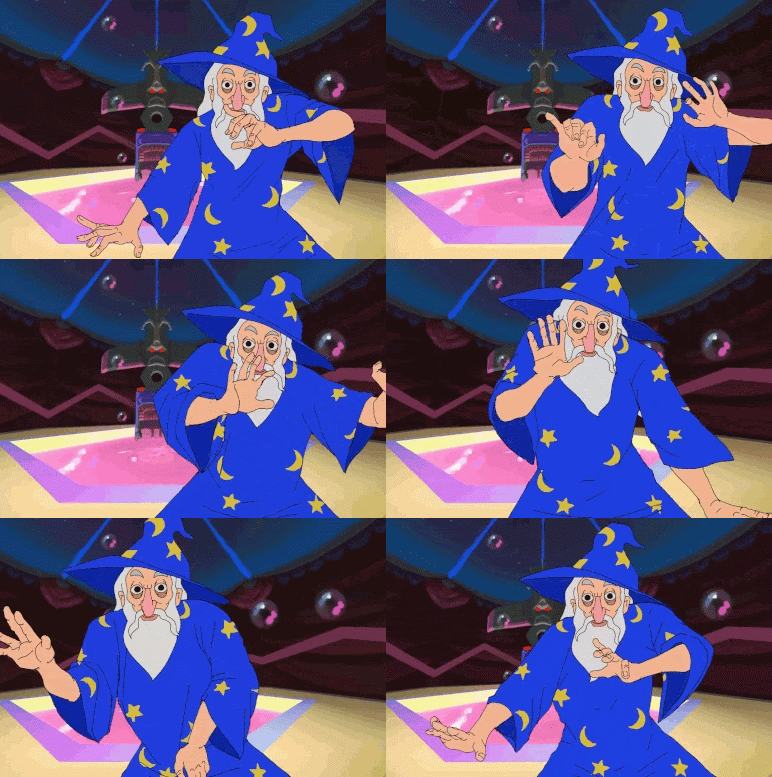
An animated gif of a wizard dancing ominously

You just know this guy is going to Counterspell you. From Ena: Dream BBQ


You Can Counter a Spell of the Opposing School

I’ve written before that the schools of magic are an underutilized source of worldbuilding in D&D. What if those rivalries define what a wizard can counter? This gives some mechanical teeth to an interesting worldbuilding feature.

If limiting Counterspell to only these rivalries makes the spell too niche, we could simply say that on top of the normal language of Counterspell, countering a rival school's spell counts as if it was done with a slot two levels higher than what was actually used.

Combine All Three

You could create a system where the baseline is that a third-level slot can counter a first level spell, but if the caster knows the spell, that reduces the cost by one, so that they could use a second-level slot. Same thing if they are a member of an opposed school. But countering a spell of one’s own school would add a level, making it more difficult. 

I don’t really recommend this, because it’s crossing the line from “reasonable homebrew” to “oops this is a new magic system.” But go where your heart takes you, wizard.

Tuesday, April 8, 2025

Worldbuilding Implications of the Megadungeon as Literal Underworld

Last Week: Death in Depth Within the Mythic Underworld

Last week we explored how to make the mythic underworld a literal one as well. This adds a risk/reward mechanism without defanging death, and rescuing an ally from death provides a reason to delve deeper into the dungeon than the party otherwise would.

Does this concept mean that the dungeon is loaded with ghosts? Well, yes, but not the undead wraiths and banshees the PCs are accustomed to. The typical shade is an invisible, barely perceptible presence. 

But they can subtly influence the dungeon. A door slams shut when no monsters are nearby? A shade, agitated to a brief moment of corporality. A new torch goes out in a dungeon hall without so much as a gentle breeze? Snuffed by a shade.

But otherwise, shades are unseen and undetectable, even by magic that finds the invisible and the undead. The lost soul the PCs search for is the exception. Because of their personal connection to the dead adventurer, the PCs can spot a soul they know, once they are close.


An image of Orpheus rescuing Eurydice from Hades

"But my gear! But my loot!"


What if a PC dies, and the die roll indicates a result deeper than the deepest level of the dungeon? That means, at minimum, that the soul cannot be rescued until the DM decides to expand the dungeon. Indeed, in a meta sense, the deaths of powerful adventurers may be the genesis of many deep layers of megadungeons. Perhaps the newly created levels reflect the soulscape of the doomed PC that was banished there. The DM should create new levels at their leisure, and notify the players when a rescue is possible.

This works best in megadungeons where the dungeon becomes strange and inscrutable in its lower levels. Not just “very old tombs” or “entrance to the underdark” strange. Strange like ancient mythological beliefs that deep caves were literally the access point to the afterlife. The idea that the underworld is a physical space connected to the normal world, where one can go, and – at great risk – attempt to rescue someone is, of course, part of Greek myth, as well as various other mythologies. This idea could work best in a setting that folds the planes into the “real” world, rather than treating them as alternate dimensions or foreign planets, the way some of D&D’s settings have in the past.


Tuesday, April 1, 2025

Death in Depth Within the Mythic Underworld

One of the signature motifs of the OSR genre is that the dungeon is the mythic underworld. What if it is also the literal underworld?

If a PC dies within the dungeon, their soul is banished to the underworld… which is to say, a deeper part of the dungeon. How deep? Take the character’s current level, round down to the closest standard die size used in the game, and roll that die. That’s how many levels down they go from where they died.

For example, say a fifth-level character dies on the third level of the dungeon. The player rounds down from five to four. They roll a d4 and the result is a 3. The current level plus three means their soul is now trapped on the sixth level of the dungeon.

The soul might descend straight down, or they may be sent to some random part of the new level. The character’s soul cannot do anything about their predicament on their own. They are a shade, lacking the physicality and ego to alter their situation. They will drift endlessly down here… unless their companions decide to come rescue them.


Orpheus rescuing Eurydice from the underworld

"Babe please come back you were only 30 XP away from leveling up"


Complicating Rescue 

Exploring the dungeon is a dangerous idea. Attempting to save a soul trapped in the dungeon is much riskier. The additional danger can take a few forms.

Bargain

The rescue party has to make a deal with someone to take the rescued soul back up to the surface. The doomed soul is literally bound by high magic (ninth-level equivalent or greater) to the dungeon floor they’re on. But there’s someone on this dungeon level who can make an exception. This might be a literal lord of the afterlife, gatekeeper, or psychopomp. Or it may be some ordinary dungeon faction or monster that has been gifted this authority by the dungeon’s gestalt consciousness. Either way, this is no ordinary jailbreak. The PCs should be expected to do something difficult or give up something precious to bargain for the lost soul. 

Fade

The lost soul is fading. Shades only last so long before their consciousness dilutes into the ambient fabric of the underworld. If you want to rescue them, you’re on the clock. It is at the DM’s discretion how much time the PCs have, but it should be known to them (or discoverable), and the more powerful the lost soul, the shorter the clock. 

Exchange

The soul can be returned to the surface, but another soul must take its place. It must be a willing soul, not some innocent or random dungeon denizen kidnapped from an upper level (or at least, it can’t be without serious consequences for this crime, which is not just an ethical and moral issue, but also a violation of the rules of the afterlife). It must be a member of the party, or someone they care deeply about, and the sacrificed soul can’t later be rescued in turn; they’re gone forever.

Geas

The rescued soul can leave, but only because Death has found a greater purpose for them. Perhaps some far greater transgressor is out there in the world – a lich or another immortal whose soul, so long withheld from the reaper’s rightful grasp, has become a rich prize. The rescued soul is bound to pursue whatever quest Death gives them. As with other consequences, this is high magic, and is (almost) impossible to subvert or cheat.

Next Week: Worldbuilding Implications of the Megadungeon as Literal Underworld


Tuesday, February 25, 2025

When Is a Nerf Actually a Buff?

When is reducing the power of a character’s ability (“nerfing” it) actually making it stronger, in the context of a specific campaign or game concept? When the original character ability solves a challenge so completely that GMs simply stop including that challenge in the game. A nerf to such an ability returns that ability to relevance.

I ran a multi-year D&D 5E game from first level to well beyond 20th level. D&D 5E uses banded accuracy to control the runaway escalation of bonuses and modifiers that plagued previous editions. Banded accuracy works pretty well through the first 10 levels, but D&D 5E kinda falls apart beyond that point (although that can actually make the game more interesting). The following examples are all based on the 2014 version of 5E; the principle is less likely to occur in OSR or story games, where there’s less of a presumption of power balance. But the underlying idea is worth keeping in mind for all games.

For example, rogues at 11th level get an ability called Reliable Talent, which effectively puts a floor on their proficient skills. With Reliable Talent, the Expertise ability, a pair of thieves’ gloves, and a maxed-out Dexterity score, the party rogue in this game rolled dexterity-based skill checks ranging from the high teens to the mid-30s. 

For skills like stealth, this was manageable, because there was always room for enemy countermeasures. The highest stealth roll in the world won’t negate the effect of Alarm, a first-level spell that can be cast as a ritual. And an individual character with very high stealth tends to separate themselves from the group in ways that create interesting situations

But what about skills that have less prominent counter-play? What about picking locks? When designing locations for the party, I struggled with how to lock the damn doors in a way that was ludologically meaningful. This was the theme of several of my earliest posts, about how quickly a mundane locked door ceases to be a meaningful barrier in D&D.


Lockpicking in Hillsfar (1989) 

I had the following options, none of them great.

  1. I could leave locked doors out of the game entirely. Not realistic, and would negate the ability the rogue had invested in building up.
  2. I could inflate the DCs, preserving the challenge. But it would be transparently obvious that I was doing so artificially to “counter” the unbounded scaling of this particular ability.
  3. I could leave locked doors in the game, but bypass the wasted time of rolling, and just say the rogue succeeds unless there is a trap or other complicating element. 
  4. I could nerf the rogue’s skill to bring it back into line with the bounded accuracy system.

At the time, I went with a combination of options 1 and 3. I was never entirely satisfied with how those played out. I think option 2 is simply wrong. Option 4 was hard to consider for an ongoing game, but was… interesting.

Let’s consider another example. Paladins in 5E can easily cure non-magical diseases. On paper, this is evocative and makes sense. In practice, this means that most 5E games don’t bother to include non-magical diseases in their scenarios. I had a paladin in that 1-20+ 5E game as well, and the ability to cure non-magical diseases came up… two or three times? Not nothing, but it was very rare.

So what if we nerfed the paladin’s ability? How could that possibly be a buff?

Because if the nerf allows disease to matter in the game, the paladin will actually have opportunities to use the ability.

Imagine a campaign setting dominated and defined by a widespread, highly contagious plague. Even if the GM nerfed the paladin’s ability to cure diseases, relative to the 5E base rules, a player might get a lot more use out of that ability in a situation where the challenges include the presence of disease everywhere. 

There are more possible examples. The 2014 5E ranger famously has exploration- and survival-oriented abilities that, uh, basically trivialize traditional RPG exploration and survival. Getting lost and getting hungry are uninteresting challenges in a 5E group that includes a ranger (or to some degree, a character with the outlander background). Weaken that ability… and the ranger, counter-intuitively, becomes more useful and interesting, because navigation and survival are real dangers in a game where the ranger doesn't trivialize these challenges.

There are probably other examples, but this is enough to say – consider instances where nerfing an ability will actually make it more relevant to gameplay. If this is session zero, discuss it with the players. If you’re hacking a game in progress, talk to the players and see what abilities they have that they rarely use. You might be surprised how readily players will sacrifice a bit of on-paper power to ensure the DM can actually create opportunities for them to use those unique abilities.

Tuesday, February 4, 2025

Mystery TTRPG Scenario: Recruiting the Suspects

The fiction at the intersection of mystery novels and social deduction games (like Werewolf or Blood on the Clocktower) prompted this idea for a mystery scenario in a TTRPG. This framework could work for any game where a mystery is central to the campaign premise; it is, like my last mystery pitch, otherwise setting- and system-agnostic. It simply needs various NPCs who are suspects in whatever the substance of the mystery is. We’ll use a murder as a classic example, but it could be adapted to any kind of mystery where the goal is to figure out who knows the truth or who is responsible for the central mystery.


https://digitalcollections.nypl.org/items/6c6a5d5a-5c6d-6a49-e040-e00a180626f1

"Hey, can someone figure out who killed me? I'll be waiting right here. Thnx."


The structure of the scenario is as follows:

  1. The PCs are trying to solve a murder. They are on the clock (literally or figuratively, as in clocks from Blades in the Dark).
  2. Various NPCs are suspected of the murder.
  3. One (or more) of those NPCs is actually guilty of the murder, and wants the mystery to remain unsolved, or to be solved incorrectly.
  4. The rest of the suspects genuinely want the mystery solved, either as a matter of principle, or because they cared about the victim, or merely so that they themselves will be exonerated.
  5. Each and every suspect has a key secret. This is something they want to conceal, possibly because it is illegal, immoral, embarrassing, or compromising. No key secret should be on the same scale of importance as the central mystery, i.e., no suspect is guilty of anything as bad as murder. A key secret should be something like an affair, a civil crime like embezzlement, a child born out of wedlock (in a culture that forbids it), sketchy foreign entanglements, or something similar. Serious issues that would influence the NPCs’ behavior, and will incentivize them to lie and deceive, but decidedly Not As Bad As Murder. This is a common trope in many mystery stories, where the detective interrogates someone who is suspicious or evasive. They eventually learn their key secret, but doing so only removes a red herring from play; it doesn't solve the central mystery.
  6. Each and every NPC suspect can be recruited to help solve the mystery by the PCs.
  7. Recruiting a suspect gets the PCs access to everything the NPC knows, except for their key secret. The NPC will still lie and dissemble to hide their key secret.
  8. Aside from their key secret, the NPC suspect will help as best they can to solve the mystery, offering any individual knowledge they have of the crime, as well as any skills or expertise they possess. However, their help comes at the cost of complications stemming from the key secret itself, or actions they take to hide it. Depending on the system, the “cost” can be a concrete game mechanic, like a GM intrusion, or something more implicit and abstract. Either way, the players should see the connection between the NPC and the resulting complication.
  9. However, if the PCs figure out the NPC’s key secret, this tension is resolved. From that point on, the PCs can take advantage of the NPC’s help without complications or costs.
  10. Remember that one of these NPCs is actually guilty of the murder. The murderer can be recruited just like any other NPC. Their key secret, of course, is that they’re the murderer.
  11. If the party recruits the murderer, the GM starts a hidden countdown clock (or speeds up an existing clock) as the murderer tries to undermine the PCs or complicate their instruction.

This hits on a lot of things I want from an RPG premise. Time pressure. Resources at a cost. Players rewarded for asking questions and figuring things out. Consequences that make sense to the PCs. Motivations that make the players say “ohh, of course” after the mystery is solved. Now I just need to find an occasion to run this scenario. The clock is ticking…

Tuesday, January 14, 2025

Mystery TTRPG Scenario: Flashback Theater

This is a concept for a mystery one-shot, or a single-session scenario that we can drop into a larger game. Inspired by the excellent mystery video game Return of the Obra Dinn, and my experience using flashbacks in several RPGs, in turn inspired by their use in Blades in the Dark.

The PCs are tasked with solving a mystery. They need to solve it at the location of some major event. We’ll use something tropey as an example: a mansion where a dozen people were murdered at different times, in different ways, possibly by each other; possibly by a killer who is now on the loose; possibly some combination of both, or something else entirely. There are no survivors, and the forensic evidence at hand is insufficient or contradictory. The PCs are tasked with determining who killed who, and why. Fortunately, they have access to some magic or technology that allows them to flash back to the events of the night when the murders took place.

When the PCs flash back, they temporarily take control of one or more NPCs in the flashback scene. Depending on the number of PCs in the party, the number of dead NPCs, and the desired length and complexity of the session, we could frame this a few different ways. One PC could flash back at a time. Or the entire group could flash back and control different people in the scene. Or the party could control a single NPC by committee.

Regardless of method, the flashbacks – like any flashback in a TTRPG – will include both fixed and fluid information. Nothing in the flashback can contradict already-known facts that were established by the present-day condition of the location, or facts established in previous flashbacks.

Most importantly, the PCs cannot save the NPCs they control during flashbacks. Their fates are sealed. Every flashback is going to end with one or more deaths. But beyond that fixed end point, the PCs have broad discretion to play these characters as they wish.

Players can (and to an extent should) play these characters as they would act in the scene. These characters are trying to survive, even if the players know they won’t, and it is good roleplay to act out their futile attempt to live. But players should also treat these characters like 0-level characters in a funnel. Their deaths are a matter of when, not if, and they should be viewed as a means to an end, not a long-term vehicle for self-identification, performance, and role-actualization through play. The real goal is to have these characters act in a way that generates information that the present-day PCs can use to solve the mystery.


Scene of the Crime


The PCs do not necessarily encounter the flashbacks in chronological order. Indeed, experiencing them out of order creates an extra challenge. Obviously any flashback must conform to a previous flashback that predated it. If a flashback at 6 p.m. in the gallery establishes that the valuable diamond was stolen from its glass case, a “later” flashback taking place at 8 p.m. should not feature the diamond still in the intact case. 

But flashbacks also need to respect previous flashbacks that come chronologically after them. If an 11 p.m. flashback features a time bomb going off in the foyer, then a “later” flashback taking place at 10 p.m. should commit to the idea that the bomb is ticking down, and no action that the characters take during the 10 p.m. flashback can contradict what has “already happened" in the 11 p.m. flashback. If the bomb appears in another room in an “earlier” flashback (which happens "later" in present-day time), someone or something needs to move it to the foyer.

So in one sense, the characters have enormous flexibility when flashing back to ask questions or gather information that will help them solve the mystery in the present. But the more times they flash back, the more established information will constrict their actions in future flashbacks.

To enforce the complications of fixed information, the GM will need to carefully note what and who is where and when. A table divided by location on the x-axis and time of day on the y-axis is likely helpful, noting a few key details for each flashback; who was present, who died (if anyone), and what important items were present. The game of Clue is instructive here; if the PCs can answer a classic who/what/where question posed in Clue style, they have likely solved part or all of the mystery. 

The PCs get one flashback per room per hour-long time slot. So if the mansion includes six rooms of interest, and the events occurred between 6 p.m. and midnight, there would be 36 possible flashbacks to solve the mystery.

Tuesday, October 15, 2024

Roleplaying Games Are Nomic Games

Roleplaying games, particularly in their most freeform state, are often a kind of Nomic game. Per Wikipedia:

Nomic is a game created in 1982 by philosopher Peter Suber, the rules of which include mechanisms for changing those rules, usually beginning by way of democratic voting.[1] The game demonstrates that in any system where rule changes are possible, a situation may arise in which the resulting laws are contradictory or insufficient to determine what is in fact legal.

Initially, gameplay occurs in clockwise order, with each player taking a turn. In that turn, they propose a change in rules that all the other players vote on, and then roll a die to determine the number of points they add to their score. If this rule change is passed, it comes into effect at the end of their round. Any rule can be changed with varying degrees of difficulty, including the core rules of the game itself.

Peter Suber’s book, The Paradox of Self-Amendment, is available here. Appendix 3, beginning on page 199 by the PDF pagination, is about Nomic. But the Wikipedia summary is sufficient for understanding the basics.


Calvinball

Calvin and Hobbes by Bill Watterson


The logic behind Nomic subtly influences many kinds of games. Calvinball from Calvin and Hobbes is, of course, explicitly a Nomic game. It lacks the rigor of Nomic, as well as enough players to incentivize negotiation through voting, something Nomic’s rules specifically identify as an issue: 

Two can play, but three or more make for a better game. With only two players, there is no (initial) difference between unanimity and majority rule, which takes away a lot of the fun. 

But in spirit, it is so accurate to Nomic that I wonder if Calvin and Hobbes creator Bill Watterson read the original Scientific American article and got the idea there.

Other, more conventional games have Nomic qualities, insofar as there is almost always a socially navigated layer of agreement above the actual rules of the game. Common games played with standard decks of playing cards, for example, typically have many variations or house rules. The game cannot begin until the players agree on the rules they are using.

Even if the rules and procedure of the game are unambiguous, unforeseen events can arise that can only be resolved by group concurrence; which is to say, through a Nomic overlayer. What happens when a card is accidentally revealed? Do the players shuffle it back into the deck? Discard it? Is it replaced or not? Even a decision as simple as ending a board game before anyone has won involves a group discussion of whether to just conclude the game without a victor, or set the pieces aside to continue later. 


Calvin and Hobbes by Bill Watterson


But TTRPGs are perhaps the most natural type of game to incorporate Nomic aspects. Even the loosest RPGs have some structure or rules; otherwise they would simply be freeform improv sessions (and there is nothing wrong with that; but it is no longer a "game"). And even the tightest TTRPGs, with the most intense procedure and the strictest rules, will inevitably require Nomic negotiation to amend and patch the rules, because as a game system, a TTRPG is an engine that produces corner cases, contradictions, and exceptions.

Nomic games cut directly to the idea of the social contract that is crucial to TTRPGs. Suber's anecdote about removing the rule that says "follow the rules" in the Paradox of Self-Amendment is instructive:

After Nomic was first published in Scientific American, a German philosopher wrote to me insisting that Rule 101 (that players should obey the rules) should be omitted from the Initial Set and made part of a truly immutable shell. He missed an essential point of the game. Rule 101 is included precisely so that it can be amended; if players amend or repeal it, they deserve what they get.

Surely everyone who has played TTRPGs – particularly at a young age – has encountered this problem, right? When my friends and I were kids, and D&D took the place previously held by purely freeform imaginary storytelling, we learned that while the rules were optional, we had something to gain by the constraints they imposed. The need to abide by rules to keep a game coherent is obvious and intuitive with a board game, and even more explicit with a video game, where (short of cheats and mods) one typically cannot alter the game’s rules much, if at all. 

But TTRPGs give the players more freedom than almost any other type of game. And with that freedom comes responsibility. There are no guard rails preventing you from changing, distorting, and ruining the game. And that’s what makes TTRPGs so fascinating.


Calvin and Hobbes by Bill Watterson


Tuesday, October 8, 2024

Bonded Skills Through Flashbacks to Scenes of Bonding

I previously wrote about the disconnect that occurs in RPGs when the player doing most of the talking isn’t controlling the character with the best social interaction skill or ability modifier. I proposed several solutions to this source of dissonance. Here’s another. I have not (yet) tested this in a game.

When the PC doing the talking rolls to determine their success in a social scenario, they can use another PC’s superior modifier (or applicable skill, or die size, or whatever, depending on the system). In exchange, the two players must either collaboratively describe or act out a brief flashback between their characters.

The flashback should be short – five minutes is good. It should be something new; it can’t just rehash already-known events. It should have at least some indirect connection to the current social interaction. It doesn’t have to be direct and explicit; it could be indirect, or even metaphorical. But the two PCs need to establish some kind of connection between their characters, and explain how that past bond helps the character acting in the present exceed their solitary skillset.

An easy example is mentoring. Picture a scenario where the crude barbarian has to make a speech to the frog parliament. The charismatic bard would normally speak for the party, but the frogs want to hear the barbarian speak in their own words. The barbarian’s player would like to take advantage of that bard’s modifier on this roll. So the two players collaborate on a flashback to a month previous, when the barbarian reluctantly sought out the bard for speaking advice on some completely unrelated matter. That advice and mentoring now comes through in unexpected ways as the barbarian makes a still-crude – but surprisingly effective – argument to the assembled notables.


An AI-generated image of a barbarian addressing the frogs; the AI decided the barbarian should be kinda froggy too, but yellow, landing on a sort of Battletoads vibe


That’s a pretty direct example, but players could absolutely run with less literal ones. A flashback to an inconsequential chat during a quiet moment of downtime or the long boredom of travel could prove surprisingly relevant to an unanticipated scenario in the present. Players could put the focus on events that are certainly important to their characters, but rarely come up “on camera” in session; eating a meal together, for example. A flashback could also do double duty and resolve a loose thread, e.g., dealing with a minor antagonist from the characters’ early days.

Flashbacks like these are done best in small doses. Too many flashbacks can drain urgency and focus from the present scenario. Once per session, or less, is probably good for most games. Or, alternately, include a rule that each PC must do a flashback with each party member once before clearing their tally and having the option to “bond” with anyone once again. That would ensure that players don’t strictly conduct flashbacks just with the one character with the most desirable skills.

This idea could be applied to various kinds of skill and ability checks, with enough creative imagination. But social interaction is the space where I see players struggling with this player/character disconnect the most.

Tuesday, September 10, 2024

Your Days Are Numbered, and So Is Your HP

This character creation idea arrived in a dream. I wrote down the broad strokes as soon as I woke up. You know you are getting good at roleplaying games when even your subconscious gives up on normal escapist dreamfare, buckles down, and starts creating mechanics and hacks. If you’re not going to go to sleep, brain, then you might as well get some work done.

Roll stats as normal for a D&D-style game, 3d6 down the line, no dropped dice or modifiers. Keep these ability scores; they work as is typical.

Also sum up the results of all stats. This will give each character a number between 18 and 108. Each player subtracts that number from 108. The resulting number is their HP.

For example, I just rolled a character and got 4, 11, 14, 12, 14, 10, for 65. 108 minus 65 is 43 HP.

That’s a lot of HP, right? Well, there is no maximum/current distinction in this model. HP is a non-replenishing resource. So it may sound like a lot, but it has to last you your entire adventuring career.

In the grand spectrum of HP, from “literal combat wounds” on one end to “luck” or “fate” on the other, this is closer to the latter. The more heroic a character is – the higher their stats are – the more Fate expects them to burn brightly, but briefly. These adventurers are like Achilles; they are the best at what they do, but they’re not going to last that long. Fate has decreed it to be so, and Fate will have its way.

Yes, this means that a first-level character with 18 ability scores across the board would have 0 HP. They would literally die in one hit. A wretch with all 3s would have a comparatively massive 90 HP to work with. But because the math is averaging six stats together, most characters will end up a lot like my example above (the mode character in this system should be at 45, so I was just two points off).

For a more forgiving version, treat this HP more like Bastionland-style hit protection, and have damage spill into ability scores. Or allow for (very modest) increases to HP, either through leveling up, or through some intrinsic mechanic within the game (perhaps bargaining with Fate).

Tuesday, August 20, 2024

Going Up, Going Down: Incrementing Die Sizes for Information Density

I've occasionally seen people online present six related random tables, with each table tied to one of the classic polyhedral die sizes. For example, rolling a d4 to choose a location, then a d6 to determine what’s currently happening there, then a d8 to decide what monster is present, and so on.

I don’t know where this idea originated, or if there’s a proper name for it, or how far back it goes. It’s just a nice execution, because it’s satisfying to roll a fistful of dice all at once and then discern the results. It’s a fun prep technique, but a little too time-consuming for use at the table. Still, there’s something compelling about using all six of the main dice in one throw. What kind of similar ideas would be more useful at the table?

Picture a single random table, numbered 1-20. The entries near the bottom of the table are positive (or at least neutral) for the PCs, while the ones at the top are increasingly negative. For example, in a dungeon, a result of 1 could be something simple like a torch burning out, while 20 would indicate a random encounter with the most dangerous monster in the joint.

When you first roll on this table, use a d4. Interpret the outcome of the result, then cross it out. If you roll that same result a second time, nothing happens, but you permanently increase the die size to d6. Continue in the same fashion, increasing the die size to d8 and so on whenever you hit a previously rolled result that has already been crossed out. If you reach the d20 and can no longer increment upwards, treat re-rolls of previously rolled monsters as the nearest as-yet-unrolled result (and cross it out afterward). 


An AI-generated image of a row of progressively larger dice; interesting that the AI easily understands the platonic dice and doesn't default to d6 only


Rolling Downhill


The above method builds in a time delay for the really tough stuff. The increasing die means that the worst danger from the deepest part of the dungeon won’t show up while exploring the first room; but the incrementing dice and crossed-out possibilities mean that the more time the party spends in the dungeon, the more certain it is that those events will eventually happen.

What if we want at least a chance that the biggest dangers show up early? We can turn this around and put the bad stuff at the low end of the number range, and the good (or at least relatively "less-bad") results at the top.

Start with the d20, and roll as usual on the 1-20 table, crossing off results as you go. When you reroll a previously rolled result, switch to the next-smallest die. So the DM could roll 6, 11, 3, 20, 11, crossing out each of those results. When the second 11 is rolled, the die increments down to the d12; results 13 and above are now out of range.

This one will run on a much more aggressive clock, and after a handful of encounter rolls, the PCs will quickly get into hot water. For some counterplay (and a chance to still use numbers that have fallen out of the shrinking die range) give the players a way to release steam from the dungeon. Say that every favorable negotiation or parley with an NPC or a faction can increment the die back up by a level. Or exploring a certain number of rooms. Whatever connects to the intended gameplay loop and provides some motivation to the PCs.

There’s nothing special about either of these systems that makes them “better” than conventional random event or dungeon exploration tables. They merely take advantage of the natural tactile appeal of the varying sizes of polyhedral dice. And for in-person games, the d20 (in the first system) or the d4 (in the second system) is a powerful sign to the players that they are in as much danger as the dungeon has to offer. 

Stolen Board Game Mechanic: Divide-and-Choose Spells

Various types of boardgames and card games include “I cut, you choose” mechanics. One player divides a quantity of tokens, or cards, or some...